True Random Number Generator 25
 That comment is from "slebyh":
slebyhSeptember 21, 2015 at 4:46 PM
shared on fb!
ReplyDelete"slebyh," if you'll write to me at chris.keith@stmarys.ac.uk, I'll arrange for you to receive your book! Congrats!

 That comment is from "slebyh":
 Today we welcome the first of our new bloggers to the Jesus
Blog—Dr. Christine Jacobi. Christine is wissenschaftliche
Mitarbeiterin at Humboldt Universität zu Berlin and is a perfect addition to
the Jesus Blog because she is an innovative scholar working in the area of
Jesus tradition in the writings of Paul.
As is standard in the German system, she is currently writing her second
doctorate (Habilitation) under Prof Dr Jens Schröter, whom readers of
the Jesus Blog will recognize as one of the leaders in recent historiographical
shifts in Jesus studies. Christine also
wrote her PhD in Berlin under Schröter, which was published as Jesusüberlieferung
bei Paulus? Analogien zwischen den echten Paulus-Briefen und die synoptischen
Evangelien (de Gruyter, 2015).
In this study, Jacobi argues that restricting consideration of Paul’s
knowledge of the Jesus tradition to mining his epistles for words and sayings
of Jesus from the Synoptics is ill-conceived.
One must, according to Jacobi, be more attuned to Paul’s own
conceptualization of Jesus and the Jesus tradition. Focusing particularly on his usage of “in the
Lord,” she demonstrates that Paul “receives” “Jesus” as more of a hermeneutical
sphere or orientation toward the past than anything else, and thus his
reception of Jesus and Jesus tradition amounts to much more than simply
repeating some words that Jesus may have said.
This study is one of the first applications of the emerging “memory approach” to
the Pauline epistles, and is thus groundbreaking in that and many other
ways. We could not be more pleased to
have Christine join us and we look forward to her contributions. I (Chris) should also mention that I’m
particularly pleased to be working with Christine as a co-editor (along with
Helen Bond and Jens Schröter) of the forthcoming 750,000-word Reception of
Jesus in the First Three Centuries (Bloomsbury T&T Clark). She is also the co-editor (with Jens
Schröter) of the forthcoming Jesus Handbuch (Mohr Siebeck, 2016).
Today we welcome the first of our new bloggers to the Jesus
Blog—Dr. Christine Jacobi. Christine is wissenschaftliche
Mitarbeiterin at Humboldt Universität zu Berlin and is a perfect addition to
the Jesus Blog because she is an innovative scholar working in the area of
Jesus tradition in the writings of Paul.
As is standard in the German system, she is currently writing her second
doctorate (Habilitation) under Prof Dr Jens Schröter, whom readers of
the Jesus Blog will recognize as one of the leaders in recent historiographical
shifts in Jesus studies. Christine also
wrote her PhD in Berlin under Schröter, which was published as Jesusüberlieferung
bei Paulus? Analogien zwischen den echten Paulus-Briefen und die synoptischen
Evangelien (de Gruyter, 2015).
In this study, Jacobi argues that restricting consideration of Paul’s
knowledge of the Jesus tradition to mining his epistles for words and sayings
of Jesus from the Synoptics is ill-conceived.
One must, according to Jacobi, be more attuned to Paul’s own
conceptualization of Jesus and the Jesus tradition. Focusing particularly on his usage of “in the
Lord,” she demonstrates that Paul “receives” “Jesus” as more of a hermeneutical
sphere or orientation toward the past than anything else, and thus his
reception of Jesus and Jesus tradition amounts to much more than simply
repeating some words that Jesus may have said.
This study is one of the first applications of the emerging “memory approach” to
the Pauline epistles, and is thus groundbreaking in that and many other
ways. We could not be more pleased to
have Christine join us and we look forward to her contributions. I (Chris) should also mention that I’m
particularly pleased to be working with Christine as a co-editor (along with
Helen Bond and Jens Schröter) of the forthcoming 750,000-word Reception of
Jesus in the First Three Centuries (Bloomsbury T&T Clark). She is also the co-editor (with Jens
Schröter) of the forthcoming Jesus Handbuch (Mohr Siebeck, 2016).He continues, "The Jesus tradition contains multiple historical theologies about Jesus." Let's reiterate that all historical reconstructions are plural. There is no such thing as the "historian's Jesus"; there are Jesuses of many and varied historical reconstructions. Of course, we try (or ought to) make sense among ourselves and thus attempt to create a coherent collection of narratives. Moreover, some of these narratives will prove better than others and eclipse others in our collective dialectics. Is this all that different than the theological process of creating doctrinal insiders and heterodox/heretical outsiders? Isn't a similar power dynamic at work in both dialectics?The historical Jesus was a theologically-interested and invested human being. The Jesus tradition was created by theologically-interested and invested authors. Consequently, using theological language and vocabulary in order to understand the origin and development of this historical figure and tradition is virtually unavoidable. It is the interplay of social, economic, political, and theological forces that converge to create and sustain religious movements. The sociological structures of the Jesus movement, the economic pressures on rural Galilee, the political landscape(s) of the Herodian era, and the ideological and theological streams of thought and practice all shaped the lives of first-century Jews. History, in other words, is not simply a record or description of past events, but analytical explanations of the causal forces that generate events. So if our texts represent more than just the ideological thought-world(s) of the texts themselves, and we really want to understand them, then we need to understand and explain the historically enacted theologies of these particular ancient people.
I’ve been reading through Luke Timothy Johnson’s The Creed and found this provocative statement:
"[T]he most remarkable evidence for Christianity’s confusion – at both extremes [progressive and conservative] – is the fact that since the time of the Enlightenment, the longest-running of all Christologies heresies has deeply infiltrated the church with scarcely any protest or controversy, much less the calling of a council of bishops to clarify and defend the faith of the church. I mean the replacement of the Christ of faith with the so-called historical Jesus."
I wonder what the guys at The Jesus Blog would say to that?I have a few thoughts on this. For a start, I might take issue with the claim that the discipline has infiltrated the Church "with scarcely any protest or controversy." Those of us fired and/or silenced because of our work on this topic have a different perspective.


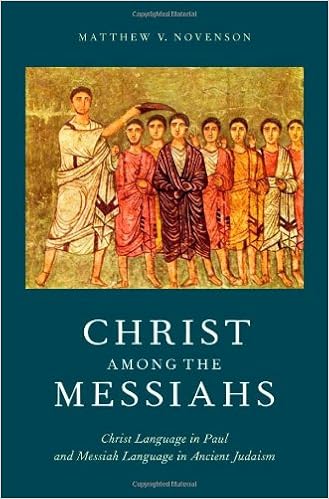
 Just this week I finished reading Jesus and Brian: Exploring the Historical Jesus and His Times via Monty Python's Life of Brian. As mentioned before, I was at the conference, so I was interested to see if it captured the serious-but-lighthearted feel of the live presentations. It did. I enjoyed this book about as much as any I have read recently. At times it's hilarious and at times it's penetrating. Here are some random thoughts I had after finishing it. (I'm not at all trying to write a formal review.)
 Second, it was interesting to see how many of the scholars brought up the Palin/Cleese "debate" with the Bishop of Southwark and Malcolm Muggeridge as well as the Not the Nine O'Clock News parody of the debate. Burridge's chapter addresses it in depth, but many of the other authors also felt the need to defend Palin and Cleese and point out the ridiculous nature of their interlocutors' comments. Of course, this is right. Their interlocutors' comments were ridiculous. But I couldn't help but wonder if some historical Jesus scholars feel a particular kinship with Palin and Cleese for having also suffered attacks and misunderstandings by ecclesiastical figures.