Baker Academic

Tuesday, November 11, 2014

TJB Endorsed Book Notice: Jesus and the Chaos of History

Book notice, Jesus and the Chaos of History: Redirecting the Life of the Historical Jesus (OUP, February 2015):

Here is the summary:
In Jesus and the Chaos of History, James Crossley looks at the way the earliest traditions about Jesus interacted with a context of social upheaval and the ways in which this historical chaos of the early first century led to a range of ideas which were taken up, modified, ignored, and reinterpreted in the movement that followed. Crossley examines how the earliest Palestinian tradition intersected with social upheaval and historical change and how accidental, purposeful, discontinuous, contradictory, and implicit meanings in the developments of ideas appeared in the movement that followed. He considers the ways seemingly egalitarian and countercultural ideas co-exist with ideas of dominance and power and how human reactions to socio-economic inequalities can end up mimicking dominant power. In this case, the book analyzes how a Galilean "protest" movement laid the foundations for its own brand of imperial rule. This evaluation is carried out in detailed studies on the kingdom of God and "Christology," "sinners" and purity, and gender and revolution.


Here is the (actual) Table of Contents:
Introduction
1. Does Jesus Plus Paul Equal Marx Plus Lenin? Re-directing the Historical Jesus
2. Criteria, Historicity, and the Earliest Palestinian Tradition
3. The Dictatorship of God? Kingdom and Christology
4. 'Sinners', Law, and Purity
5. Camping with Jesus? Gender, Revolution, and Early Palestinian Tradition An Irrelevant Conclusion

Monday, November 10, 2014

Jesus married Mary, had two kids, a mortgage, and a gym membership that he only used twice

Once, just once, could we have a hoax that claimed Jesus married someone else? Does it always have to be Mary Magdalene? According to the newest medieval rumor mill, not only does Jesus wed Mary (identified as a prostitute), the holy couple had two kids.

Greg Carey discusses the latest book that makes this claim here. Greg seems more confident than I am that Jesus never married. But we agree that the supposed document "uncovered" in the British Library is probably bogus. Moreover, the hoax contributes to the longstanding tradition of sexualizing Mary Magdalene.

Our earliest and best sources for the life of Mary tell us that she was an independent follower of Jesus. She was not attached to any male relative or husband. For two thousand years her independence has drawn rumor. This is just one more example of the clichéd male imagination.

-anthony

***UPDATE***

For a review of the book in question, Bob Cargill's is here: http://robertcargill.com/2014/11/10/review-of-the-lost-gospel-by-jacobovici-and-wilson/


Alban Books Discount for the Jesus Blog—Chris Keith

Elaine Reid at Alban Books, the UK distributor for Eerdmans and other presses, has generously offered readers of the Jesus Blog a 25% discount on select forthcoming books.  For the discounts on NT studies, click here.  For the discounts on OT studies, click here.

Saturday, November 8, 2014

A.-J. Levine to Give Cadbury Lectures

If you're near Birmingham (think Ozzy Osbourne, not Emmy Lou Harris) between Nov. 25-Dec. 3, you might interested in attending the Cadbury Lectures. Amy-Jill Levine is speaking on the topic "Is the New Testament Anti-Jewish." Levine will give lectures related to the Christmas narratives, the Sermon on the Mount, Jesus v. Pharisees, Who killed Jesus?, Paul, and the Epistle to the Hebrews.

If you've never heard A.-J. speak, you're missing something special. She is always sharp, original, and funny. For more information:

http://www.birmingham.ac.uk/schools/ptr/departments/theologyandreligion/events/cadburylectures/2014/index.aspx

-anthony

Friday, November 7, 2014

Stuckenbruck’s The Myth of Rebellious Angels—Chris Keith

On Facebook this morning, I learned that the first copy of Loren Stuckenbruck's new book, The Myth of Rebellious Angels, has been delivered.  It was delivered to his wife, so I suspect those of us who aren't married to Loren will have to wait a bit longer.  I'm looking forward to this one.

Thursday, November 6, 2014

Social Memory is a Theory, Not a Method - Le Donne

I have heard of, but not read, Mike Bird's latest book. I hope to get my hands on it soon. I was surprised to learn that Mike has embraced Social Memory theory, as he was previously uninterested in the discussion. Indeed, less than a year ago, he told me that he "couldn't be bothered with it." I imagine now that he said this tongue-in-cheek because one of his star students was (at the time) completing a dissertation that utilized Social Memory in relation to the Acts of the Apostles. I will not be able to speak to the content of his newest book (Mike's books seem to multiply like rabbits), but I think that I will say something about method. 

Mike has recently described his response to Bart Ehrman as an apologetic. I can't help but read Mike's statement about his latest book through this lens:
In a nutshell, I’d say: (1) The Gospels are historically reliable and are reasonable guides to Jesus; (2) The Gospels were probably transmitted in a complex web of oral and written traditions. (3) Social-memory is probably the best hermeneutical framework for understanding the origins of the Gospel traditions.
I'd be interested to know whether he thinks that he is doing apologetics in his latest book. But, whether or not this is a key element of his method, it will be how his book is read by many. Readers will read how they read. I've experienced this very problem with my own writing. But I digress.

I would like to point out that Bart Ehrman is also interested in Social Memory theory and will utilize this research in an upcoming book. What does this tell us? Very simply, the interdisciplinary dialectic that we call "Social Memory" is not a method, nor does it prescribe a method for the historian. Mike is quite right that it is a theory that functions as a "hermeneutical framework." I am convinced that it is indeed quite valuable for the study of Jesus and Christian origins. I've been singing this tune for a while now. But, as Chris Keith has often said, Social Memory does not itself do the work of historiography. It is an undergirding theory. How one adopts and adapts it within one's chosen method is crucial. I look forward to learning how Mike has adopted and adapted Social Memory.

-anthony

Tuesday, November 4, 2014

The 153 Fish in John 21:11—Chris Keith

I've recently been doing some research on John 21 for my next book, as well as for my SBL presentation in November.  One of the enduring curiosities of that chapter (one among many enduring curiosities of that chapter) is that the author states that the disciples' big haul of fish consisted of exactly 153 fish in John 21:11.  There are numerous places in the Bible that are simultaneously interesting and unclear, a combination that inevitably leads to some really intriguing interpretations.  John 21:11 has to rank up there with the best of them.  Augustine saw 153 as a triangular number, reducible to 17 (Wikipedia is actually helpful here), and 17 as the sum of 10 (representing the law) and 7 (representing the Holy Spirit) (Comm. Jo. 72.8).  Jerome observed that a Greek zoologist had counted that there were 153 different types of fish (Comm. Ez. 47.6-12).  The great Raymond Brown considered a number of interpretations and threw up the white flag:  "One cannot deny that some of these interpretations (they are not mutually exclusive) are possible, but they all encounter the same objection:  we have no evidence that any such complicated understating of 153 would have been intelligible to John's readers" (Gospel according to John XIII-XXI, 1075).  Interestingly, he proposes that, like the details in 19:35 and 20:7, the exact number is intended to give the impression that the Beloved Disciple is reporting the exact number of fish caught.  (He hastens to add:  "By way of caution we should note in conclusion that the explanation we have offered of the number's origin is not a solution to the problem of historicity" [1076]).  In a 2002 Neotestamentica article later republished in The Testimony of the Beloved Disciple (2007, Baker Academic), Bauckham takes us back to a numerical solution to the numerical problem.  Following M. J. J. Menken's 1985 dissertation published by Brill in NovTSup, concerning which Bauckham says, "I have seen no reference to it in any work of Johannine scholarship" (Testimony, 275n.15), Bauckham notes a number of supposed instances of numerical composition in GJohn.  For example, he argues that the Johannine prologue contains 496 syllables and the Johannine epilogue contains 496 words (Testimony, 277).  496 is not only a triangular number, but also the numerical value of "only begotten" in Greek (John 1:18; cf. also 3:16). On this basis, Bauckham then proposes that the presence of 153 is another instance of gematria, as 153 is the numerical value of the Hebrew for "sons of God," a phrase that appears in Greek in 1:12 and 11:52 (NB:  inarthrous in the former, arthrous in the latter).  Thus, gematria in the prologue parallels gematria in the epilogue, and Bauckham makes this one plank in an argument for the originality of John 21 to GJohn.

What to make of this solution for the 153 fish?  Honestly, I have no idea.  And I should be upfront about the fact that I don't have a better solution.  Further, it's abundantly clear that gematria was important for early Christians as well as the Fathers in their interpretations of Scripture.  For the life of me, though, I can't get my skeptical eyebrow to come back down when I'm reading this type of thing.

**UPDATE:  Thanks to Mikeal Parsons for pointing out his article on early Christian numerological exegesis ("Exegesis 'By the Numbers': Numerology and the New Testament," PRSt 35 [2008]: 25-43), wherein he addresses this and other issues.  Building upon Augustine's observation of 153 as a triangular number reducing to 17, he suggests that 17, being one "under" 18, indicates that the created order is "under" Jesus since 18 is the value of iota-eta, the first two letters of "Jesus."  (That 18 had special value for Christians for specifically this reason is clear in Barn. 9.7-9.)  That is, Parsons suggests the numerology expresses the theology present elsewhere in, e.g., Col. 1.16-17.

Sunday, November 2, 2014

Quarterly Quote of the Month about Jesus for this Week


"'God on the cross.' Never yet and nowhere has there been an equal boldness in reversal, something so horrible, questioning, and questionable as this formula: it promised a revaluation of all the values of antiquity."


~Nietzsche

Monday, October 27, 2014

Jesus Blog Hits 1,000 Posts and Schroeter Giveaway Winner—Chris Keith

According to our Statistics department here at the Jesus Blog, Anthony's last post was our 1,000th post.  In celebration, we're giving away Jens Schroeter's Jesus of Nazareth.  The true random number generator has spoken and the winner is the owner of comment 25.  (For some reason, it reads a max of 100, but I used 70, the number of comments.  Don't accuse us of using loaded dice, here.)

True Random Number Generator 25 Powered by RANDOM.ORG

Comment 25 is from Bob Derrenbacker, who said, "See you in San Diego":


See you in San Diego!
 
Well, Bob, you'll now have one less book to buy at SBL!

Saturday, October 25, 2014

Quarterly Quote of the Month about Jesus for this Week

But for me that Church of which the Pope is the acknowledged head on earth has as chief claim that it is the one that has (and still does) ever defended the Blessed Sacrament, and given it most honour, and put (as Christ plainly intended) in the prime place. “Feed my sheep" was His last charge to St. Peter; and since His words are always first to be understood literally, I suppose them to refer primarily to the Bread of Life. It was against this that the W. European revolt was really launched—"the blasphemous fable of the Mass"—and faith/works a mere red herring.

                             ~J.R.R. Tolkien

Thursday, October 23, 2014

Take the Conference-Participant Quiz

It is that time of year again! The masks are being touched up. The costumes are at the cleaners. The dirty tricks and sweet treats are on their way. Of course, I'm talking about the AAR/SBL fright night. Last year, I created a taxonomy of the different creatures that you're likely to meet at this professional conference. Now you can determine which mask you will don this year.

Take this quiz to find out which conference-personality type fits you best.

Wednesday, October 22, 2014

Jesus and Corporate Subsidies

My thanks to my sister, Lisa Le Donne, for pointing me to this political cartoon:


-anthony

Monday, October 20, 2014

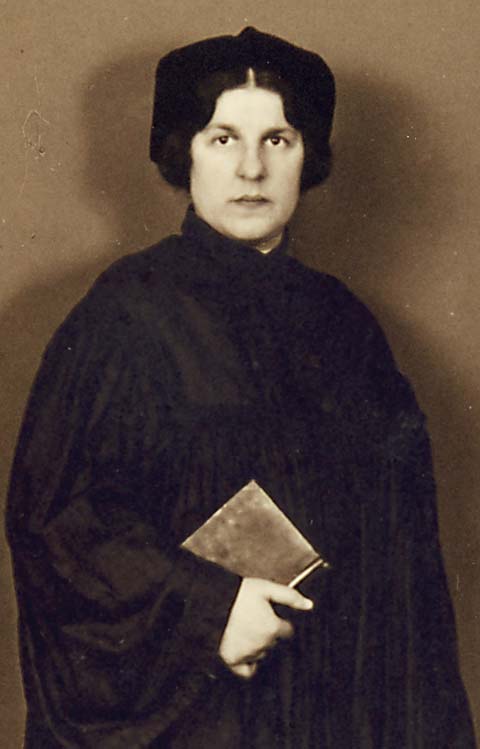
Regina Jonas and Social Memory - Le Donne

A couple days ago I was alerted to this short article by Rabbi Laura Geller. Geller showcases Regina Jonas (1902–1944). Jonas studied at the Higher Institute for Jewish Studies in Berlin until 1930 in prelude to her ordination (conducted in a private ceremony). Until very recently Regina Jonas was all but unknown to historians. She is now commemorated as the first female rabbi. While her story began to surface in the 1970s, Katharina von Kellenbach (author of this amazing and devastating book) discovered documents that confirmed Jonas' ordination in 1991. For more on Regina Jonas, see here. But Rabbi Geller's article should be read in full too for a unique window into social memory.

Here are just a few aspects of this story that interest me:

1. Social Memory theorists tell us that memory is constructed and reconstructed within social frames. Certainly gender and gender privilege operate as social frames. The vast majority of history is framed socially by masculine remembrancers. Or as Rachel Adler told me earlier this year, "Those with the 'members' get to do the remembering." Do we witness in the story of Regina Jonas a case of repressed memory due to mnemonic power dynamics?

2. Rabbi Geller writes: "in my years as a rabbinical student at HUC-JIR, from 1971 to 1976, not once did I hear her name. It would have been helpful to me, the only woman in my class, to have known her story." Could it be that the memory of Regina Jonas has found a more advantageous mnemonic frame? I.e. are the social conditions now more conducive for her commemoration?

3. If the answer to 1 is yes and the answer to 2 is yes, are we not in a better position to remember her now than we were 80 years ago? Sometimes our memories improve over the course of two generations and with the help of new social constructs.

4. Regina Jonas' story is swallowed up by the Shoah. There are times when a significant historical event eclipses all other stories that orbit it. One would be hard pressed to find a more significant event within Jewish social memory. Geller writes, "Though her thesis—“Can a Woman Be a Rabbi According to Halachic Sources?”—received praise from her teachers, none of them agreed to ordain her, including Rabbi Leo Baeck, the leader of the Jews in Germany, who wasn’t willing to jeopardize the unity of the Jewish community as the Nazi threat was intensifying." Perhaps then, Jonas' story was in the process of eclipse even before the Shoah but already within its force of gravity.

5. Finally, it would be counterproductive to create an either/or with the mnemonic frameworks discussed above. We should not think that the framework of gendered commemorative practice will entirely explain the form and function of Jonas' story. Nor should we think that the framework of Shoah commemoration tells the whole story. Mnemonic frames overlap. Indeed whenever a historical figure occupies a monolithic frame in collective memory, you can almost always be sure that the memory of that figure has been unhelpfully reduced.

I am grateful to Rabbi Geller for her short but impressive article. I will be considering this fascinating story for a long while.

-anthony