Baker Academic

Monday, October 13, 2014

C. S. Lewis on Sacred Fiction

I've found myself revisiting C. S. Lewis again in preparation for a new project. Lewis remains an odd and fascinating figure to me. In more ways that I can number, Lewis helped to create the evangelical world into which I was born and would eventually need to deconstruct. In many ways, however, Lewis did not fit well within that world. I was reminded of his complicated legacy again when my mother showed me a quotation by Lewis (thanks Mom!). He writes this in a letter to Janet Wise, October 5, 1955:
My own position is not Fundamentalist, if Fundamentalism means accepting as a point of faith at the outset the proposition “Every statement in the Bible is completely true in the literal, historical sense.” That would break down at once on the parables. All the same commonsense and general understanding of literary kinds would forbid anyone to take the parables as historical statements, …. Books like Esther, or Jonah, or Job which deal with otherwise unknown characters living in unspecified period, & pretty well proclaim themselves to be sacred fiction. 
Such distinctions are not new. Calvin left the historicity of Job an open question and, from earlier, St. Jerome said that the whole Mosaic account of creation was done “after the method of a popular poet.” Of course I believe the composition, presentation, & selection for the inclusion in the Bible, of all the books to have been guided by the Holy Ghost. But I think He meant us to have sacred myth & sacred fiction as well as sacred history.
I think that many Bible professors wish that their students possessed the category of "sacred fiction" as Lewis did. For too many, the category of "fiction" precludes the qualifier "sacred." But until this category is in place, the category of "sacred history" will be misunderstood.

-anthony

Sunday, October 12, 2014

Quarterly Quote of the Month about Jesus for this Week


"If Christians want us to believe in a Redeemer, let them act redeemed."

                ~Voltaire

Saturday, October 11, 2014

Rudolf Rocker on Houston Stewart Chamberlain and the Aryan Jesus

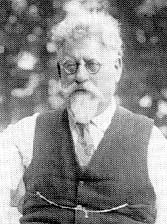
Rudolf Rocker
From 1977 onward and the work of E.P. Sanders (though not without precedent--see e.g. George Foot Moore), New Testament scholarship has become increasingly aware of previous stereotyping of Judaism as cold, harsh, legalistic, and so on. From the 1990s onward (though not without precedent--see e.g. Geza Vermes), it became increasingly common in New Testament scholarship to investigate or point out its Nazi and fascist past (largely) prior to WWII.

As a point of contrast, we might note Rudolf Rocker (1873-1958) who, during the rise of German fascism, was a fierce critic of what was happening in the place of his birth. Rocker was not a New Testament scholar but was fiercely critical of one of the more notable advocates of an Aryan Jesus, Houston Stewart Chamberlain, and his now infamous book Foundations of the Nineteenth Century (1899). Despite being an anarchist writer who had little time for religion (he believed it underpinned state and political power), he was also critical of Chamberlain's understanding of Judaism decades ahead of much of New Testament scholarship.

The following was published by Rocker in 1937 and is dripping in sarcasm:
[According to Chamberlain] the German is the specially chosen minister of the Protestant mission, through which Christendom is first made aware of its true content. That the Christian had thoughtlessly chosen the Jew, Jesus, for his savior was surely a bitter pill; it was too late to undo that. 
But was it not written in the Gospel that Christ first saw the light in Galilee? And immediately the "instinct of the race" came to Chamberlain's aid and informed him that in just this part of Palestine extensive crossing of races had occurred and, above all, that in Galilee Germanic stocks had settled. Must one not, then, admit that Christ had been a German? It was, in fact, unthinkable that out of "materialism drunken Jewry" a doctrine could come to whose spiritual content the Jewish mind is completely opposed. 
Chamberlain revealed an utterly morbid hatred of everything Jewish. He even ventured to assure his credulous readers that a Germanic child, the keenness of whose senses had not yet been ruined or blunted by the prejudices of adults, could tell instinctively when a Jew was near him....To be sure, he based his preference for the Sephardim on the assumption that they were in reality Goths who had been converted to Judaism in large numbers--a recognition which came to the great master of unproved assertion rather tardily, as it first appears in the third edition of his book. How the Goths, those genuine branches of the noble tree of Germandom, in spite of their "mystic inclination" and their inborn sense of "religious profundity," which according to Chamberlain are the heritage of their race, could throw themselves into the arms of "materialistic Judaism" with its "dead ritualism," its slavish obedience," and its "despotic God" remains an unsolved mystery. In this case the "race in their own bosoms" must have failed outright; otherwise the wonder is not explained. There is hardly another work which reveals such unexampled unreliability in the material used and such reckless juggling with bare assumptions of the most daring type.

An expanded version of this is found at Harnessing Chaos.

Friday, October 10, 2014

Jens Schröter’s Jesus of Nazareth—Chris Keith

Readers of the Jesus Blog may want to take note that Baylor University Press has now released the most recent Wayne Coppins (and Brian Pounds) translation of Jens Schroeter's work.  This book, Jesus of Nazareth: Jew from Galilee, Savior of the World, is a more accessible and student-friendly study by Schroeter that starts with the historical Jesus and goes up through modern artistic representations of Jesus.  It's a little lighter on methodology than his From Jesus to the New Testament, but still includes a really good opening chapter on what we mean when we talk about the historical Jesus and what historians can hope to grasp in their efforts.  Another strength is that Schroeter often includes archaeological evidence in the discussion.  The German original, Jesus von Nazaret, was first published in 2006 and it has already gone through at least three editions.  For anyone unfamiliar with the work of Prof Dr Schroeter, this will be an ideal place to start.  I'm really happy to see Baylor University Press taking the initiative to bring this book out in English.  It's also featured in their ad on the side of this blog.  You can click through that ad to order your own copy.  I think as well that we probably need to have a giveaway of this book.....

Thursday, October 9, 2014

Coppins, Allison, and the Kingdom of God

I am pleased to present a guest post from friend-of-the-Jesus-blog Wayne Coppins:
Status updates on Facebook are dangerous these days. My most recent Facebook update “just read Dale Allison's excursus on the Kingdom of God in Constructing Jesus - remarkable: wish I could go back and tell various undergraduates that they might not have been as incorrect as I led them to believe” resulted in a surprising invitation from Anthony Le Donne to do a guest post about the kingdom of God with a few insights from my recent reading of Constructing Jesus. This is a kind offer, which I shall take very literally, sharing only “a few insights” that will hopefully direct others to Allison’s characteristically insightful discussion. 
It is not uncommon to find students equating the kingdom of God with a notion of “heaven” in the sense of “a place up there” or “a place that Christians will go to after they die”, and I have tended to respond by saying something like “we shouldn’t think of the kingdom of God as ‘a place that is somewhere else up in heaven’, but as a way of speaking of God’s kingly rule, as a way of speaking of what things look like when God rules as king”. I still hope that such words are not completely off target, but my reading of Dale Allison’s excursus on “The kingdom of God and the World to Come” in Constructing Jesus (pp.164-203) leads me to believe that my students might not be as wrongheaded as I suspected. mea culpa. 
Rather than attempting to summarize Allison’s argument, let me pass on a few choice quotations from his excursus as a way of conveying something of its character: 
“In Luke’s account of the passion, a repentant criminal crucified with Jesus entreats him, ‘Remember me when you come into your kingdom … Jesus responds, in the next verse, with the comforting promise ‘Today you will be with me in Paradise’ … Now given that Jesus does not correct or reject the criminal’s request, given that ‘paradise’ seems to be Jesus’ substitute for ‘your kingdom,’ and given that ‘paradise’ is always, in Jewish literature, a place—the garden Adam and Eve lived in, the garden the just enter at death, the garden that the redeemed will enjoy in the world to come—we have here evidence that Luke, like Matthew, could think of the kingdom as a locale, indeed as something akin to what later Christians meant by ‘heaven.’” (183-184; for Matthew see Allison’s affirmation/appropriation of Jonathan Pennington’s interpretation of the kingdom of heaven on p. 182) 
“My judgment, then, is that hē basileia tou theou is, in the Synoptics, a realm as well as a reign; it is a place and a time yet to come in which God will reign supreme.” (201) 
“So even though I have come to the conclusion that hē basileia tou theou is more often than not, in the Jesus tradition, God’s new world, that does not exclude other meanings. The term in fact is polysemous, so that in some verses we can scarcely decide whether basileia means ‘realm’ or ‘reign’ or both or perhaps even something else. Ulrich Luz recognizes this when he writes that the kingdom of God ‘is not only the sovereignty of God in a functional sense; it is also a particular place, in which one can be … or into which one can enter.’ Although I would prefer to turn this around—the kingdom ‘is not only a particular place … it is also the sovereignty of God’—the inclusive formulation ‘not only … also’ is right.” (202) 
As this last quotation shows, Allison does not attempt to squeeze all the hē basileia tou theou texts into a single mold. What he does do, however, is provide strong arguments for the view that a good number of them mean something like God’s new world, which has at least some points of contact with what my students mean when they associate the kingdom of God with “heaven”. And so I must return to the drawing board and think about how best to talk about this key phrase, how best to discuss its continuities and discontinuities with what Christians have referred to as “heaven”, and how best to relate it to what happens on earth.
Dr. Coppins is the Founder, CEO, and Supreme Commander of Awesomeness of this wonderful blog: http://germanforneutestamentler.com/

my thanks,
-anthony


Wednesday, October 8, 2014

Who is Ignazio Perrucci?

I've been asked several times in the past few days about Ignazio Perrucci. Purported by a fake news webpage to be an archivist and historian hired by the Vatican, Perrucci is said to have discovered an early eyewitness account of one of Jesus' miracles. As I've already noted, this is a fake story put forth by a webpage dedicated to hoaxes.

Or if you need proof in black and white here is the webpage's disclaimer:
World News Daily Report is a news and political satire web publication, which may or may not use real names, often in semi-real or mostly fictitious ways. All news articles contained within worldnewsdailyreport.com are fiction, and presumably fake news. Any resemblance to the truth is purely coincidental, except for all references to politicians and/or celebrities, in which case they are based on real people, but still based almost entirely in fiction.
It should also be pointed out that the images used for this story are also fake. The supposed discovery is a collection of wooden tablets discovered at Vindolanda in 1973. I'm grateful to snopes for this information. (By the way, if you ever get a chance to visit Vindolanda, I highly recommend it. It was my favorite day trip when I lived in Durham.) As for the image of Ignazio Perrucci, this is a fake too. I'm willing to be informed otherwise, but my best guess is that Perrucci himself is a fiction. It seems that there is an art historian by this name, but the person pictured by the fake story is Ken Klukowski. Klukowski's image was lifted from this page, in all likelihood. If I'm wrong about this, I'd like to apologize to Dr. Perrucci, his mother, and the Roman Catholic Church. But at this point, I'm only offering a fake apology.

-anthony

Tuesday, October 7, 2014

Dale Martin Responds

This past week Dale Martin's provocative JSNT essay has provided this blog with a great deal of fodder. This essay was first alerted by Chris Keith, Brian Pounds offered a two-part rebuttal, I pointed readers to Simon Joseph's post, James Crossley used this topic as an opportunity to rethink a couple well-worn categories in Jesus research, and Dale Allison provided me with a few rough reflections on the essay.

Because the Jesus Blog is a full-service station, I emailed Professor Martin and offered him a chance for rejoinder. Dale does not usually tinker with social media but agreed to do so because, as he says, "the people you cite seem to be raising objections in good faith, and they are not vicious as many of my critics are (about my writings on sexuality before, and now this historical Jesus article)." I took this, of course, as a grievous insult. We've devoted a lot of time and effort trying to make this blog the most vicious historical Jesus webpage on the internet. But I decided to include his email reply anyway. Martin writes:

Monday, October 6, 2014

Reports of a New First-Century Jesus Fragment

World News Daily Report (which is not the most reliable source for news) is "reporting" that archivist Ignazio Perrucci has discovered a document written by Marcus Velleius Paterculus (c. 31 C.E.) in the Vatican. If this is not a hoax, it contains the earliest textual evidence for Jesus of Nazareth and describes Jesus' raising of a stillborn child. I do not doubt that this report will generate a good deal of speculation over the next few days.

Let's cut right to the chase on this one: this is a fake story, invented by a fake news webpage.

-anthony

Is Social Memory Theory a Fad in Jesus Studies? My Interview with Dominic Mattos—Chris Keith

Over the weekend, The T&T Clark Blog put up a podcast where Dominic Mattos, editor of Bloomsbury T&T Clark interviewed me (over a year ago now) about the current state of Jesus studies, including criteria of authenticity and the contributions of social memory theory.  Among several things he asks is whether I think social memory theory is a fad in Jesus studies.  I'll let you listen there instead of offering my full answer here, which might not be exactly what some readers of this blog would think.  Perhaps we can come back to it later on the Jesus Blog, though.

Sunday, October 5, 2014

Quarterly Quote of the Month about Jesus for this Week

“As a child I received instruction both in the Bible and in the Talmud. I am a Jew, but I am enthralled by the luminous figure of the Nazarene . . . . No one can read the Gospels without feeling the actual presence of Jesus. His personality pulsates in every word. No myth is filled with such life. Jesus is too colossal for the pen of phrase-mongers, however artful. No man can dispose of Christianity with a bon mot.”

                         ~Albert Einstein

Thursday, October 2, 2014

Thomas J. Kraus and Weirdo Text Critics—Chris Keith

Over the course of several years of reading scholarly treatments of ancient Christian book culture, including text-critical studies of the New Testament, I'm really entertained by the funny anecdotes about text critics and their perception in the guild.  Basically, most text critics know that other NT scholars think their work is boring.  In Mark, Manuscripts, and Monotheism, Thomas J. Kraus has a couple funny ones: 

"For many scholars it [textual criticism] still is a boring and bone-dry discipline for weirdos who are not creative enough to do proper theology."

"For theologians, papyrology and palaeography are still nothing more than arcane disciplines or rather bizarre occupations for strange people."

Hilarious.  If you happen to be one of those people, I'd encourage you to read the classic study of D. C. Parker, The Living Text of the Gospels, Bart Ehrman's Misquoting Jesus, or Robert F. Hull's The Story of the New Testament Text.  I'm not saying that Jason Bourne is going to be in any of them, but each of these studies in its own way shows just how fascinating the study of early Christians and their books can be.

Jesus and ‘Nationalism’


Following on from the post on the term ‘revolutionary’, I want to look at another term that is commonly used in historical Jesus research but which may also raise problems: ‘nationalism’. It is common enough to read phrases such as ‘nationalistic movement, ‘Jewish nationalism’, ‘nationalistic associations’, ‘nationalistic tendencies’ etc. Of course, as with any definition, people may be using it in ways that are based on ancient understandings but terms relating to ‘nationalism’ are not always defined and carry problematic connotations when studying the ancient world.

Probably the biggest problem is that assumptions surrounding ‘nationalism’ as associated with, for instance, the nation state, are part of a relatively modern phenomenon. In this respect it is also worth noting that the rhetoric and assumptions of modern ‘nationalism’ and nation states are embedded in the history of historical Jesus studies which emerged as a strong European nationalism was emerging. Might this not have had a profound historic impact on the assumptions of the field of historical Jesus studies?

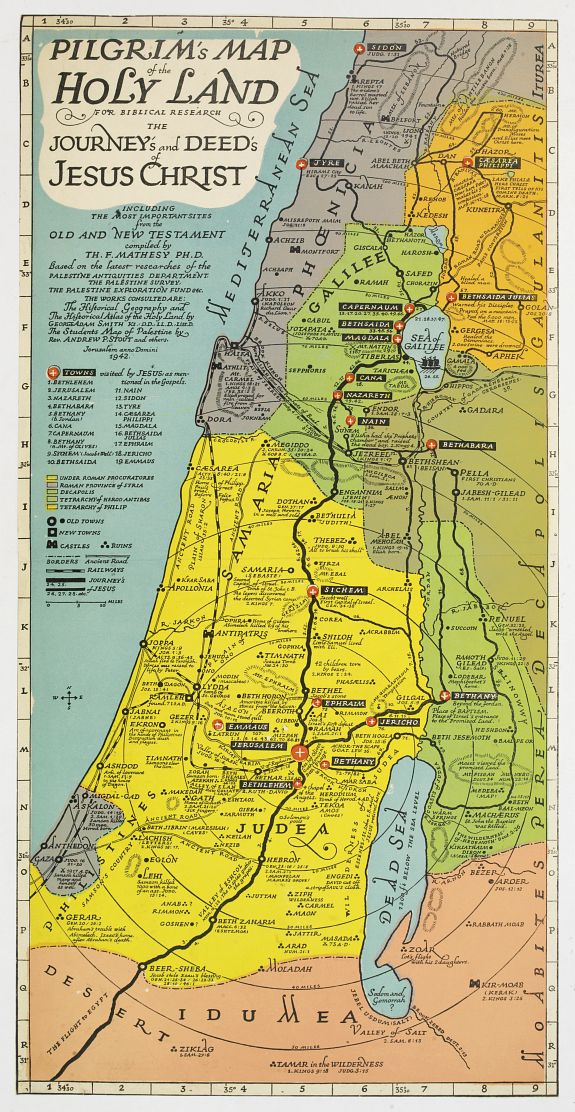
There are criticisms and qualifications of this sort of thinking about the development of nationalism and the nation state and other possibilities can be raised, such as whether we can talk about ‘proto-nationalism’.  We can at least argue that ‘nationalism’ is a phenomenon or construct that has undergone significant historical and semantic changes over the centuries and to such an extent that it can be difficult to reapply its use from one context to another. Nevertheless, what do scholars actually mean when talking about ‘Jewish nationalism’, particularly when undefined? If we could say that one possibility is something like having a king or divine king ruling over territory, what kind of territory might this be? We might imagine some thinking about territory from Dan to Beersheba or seemingly ‘natural’ boundaries such as something that stretched as far north as the Taurus Mountains (1QapGen 17.10). But what more? What sorts of borders were envisaged in ‘Jewish nationalism’? Presumably not the strict borders sometimes confidently presented in a ‘biblical atlas’. Were borders even envisaged?  What sort of political infrastructure is envisaged? Towns dependent on Jerusalem? Armies? Garrisons? Unification across territory or communities over issues like Sabbath observance and taxation?

So, should the word ‘nationalism’ even be used when talking about the ancient world?

Or am I worrying too much about definitions?

Well?

Wednesday, October 1, 2014

Dale on Dale: Allison Reflects on Martin's Essay

One of the most prominent threads of modern historical Jesus research is the thesis that Jesus was an apocalyptic prophet. I don't know if this thesis has won the day, but the voices that support this thesis have had more longevity than those supporting others. In my lifetime the voice with the most longevity and gravitas on this topic has been Dale Allison. I am of the mind that in order to make progress in our debates over Jesus' violence or nonviolence, we must discern what sort of apocalyptic categories best explain Jesus' hopes and aspirations. Professor Allison isn't so sure that (a) we can recover such categories with any confidence and (b) that a better understanding of these categories would help even if we could. I will have to think about this a bit more before I give up my initial curiosity – perhaps in a future post – but my knee-jerk thought here is that there is much more to be said about first-century apocalyptic, even if Dale has exhausted his interest in the topic.

Happily, Dale reflected a bit on Dale Martin's recent JSNT essay anyway. In the email exchange that follows, Allison offers a brief explanation of his own background to the Jesus-as-zealot thesis and asks four questions unaddressed by Martin's essay.

My questions: